


Salt Therapies—A Tradition with Modern Relevance
Salt therapies, which include gargling with salt water, neti pots, and salt caves (speleotherapy), have been used for thousands of years in both traditional and modern wellness practices. Historically, they’ve been used to support the respiratory system and promote overall comfort in the presence of mouth irritation, sore throats, and upper or lower respiratory concerns, including congestion, seasonal sensitivities, or environmental triggers.¹ ² ³
While it may seem surprising that something as simple as salt can offer support in today’s high-tech medical world, modern research is beginning to explore the mechanisms behind these traditional approaches. And in some cases, science appears to confirm what many ancient systems of medicine have long held: that salt can help support the body’s own ability to clear and protect itself.⁴ ⁵
The Importance of Mucus and the Mucous Membrane
To enter the respiratory system, airborne microbes must first pass through the mucous membrane, a critical first line of defense. This membrane is lined with cells and covered with hair-like structures called cilia, which help move mucus and trapped particles up and out of the airways.
Using a neti pot with salt water may help flush these hard-to-reach areas and support the healthy function of cilia by modifying mucus consistency.⁶ Cilia need to move in coordination to help carry out their clearing function effectively. This becomes especially apparent during challenges such as quitting smoking, when a temporary lack of coordinated cilia movement can result in persistent coughing. Practices such as dry salt inhalation or speleotherapy may support this natural clearing process.
Above the mucous membrane are two layers of mucus, forming a barrier designed to trap and eliminate potentially harmful particles. Maintaining healthy mucus and mucosal lining is essential to support the body’s defense against deeper respiratory involvement, especially during times of immune vulnerability.
Salt, Mucus and Microbial Defense
One of the fascinating features of mucus is its selectivity: it allows essential nutrients to pass while creating an environment that discourages the entry of potentially harmful microbes. This function varies between individuals and can be influenced by diet, age and season. For example, the increased incidence of respiratory issues in colder months may be tied, in part, to seasonal changes in mucus composition.
Mucus is also naturally present in breast milk, where it plays a role in shielding infants from viral exposure. In a study published in Biomacromolecules, researchers found that a mucus barrier could trap viral pathogens such as HPV, influenza A, and Merkel cell polyomavirus, helping prevent them from infecting cells.⁷ High salt concentrations were found to make mucus less penetrable, offering a potential explanation for why saline rinses and dry salt inhalers may feel soothing.
MIT researcher Dr. Katharina Ribbeck, who led this study, continues to explore how salt enhances the performance of mucus. Her research suggests that bacteria may sometimes break down mucus structure, helping viruses reach their target cells. Once viruses infect cells, they can reduce immune function, giving bacteria a greater chance to thrive. This two-way interaction highlights how supporting the mucus barrier—through hydration, nutrition, and in some cases, salt—may play a role in whole-system defense.⁸
Salt and Bacteria: What Lab Studies Show
Through osmosis, salt can destabilize bacteria by drawing water out of their cells. In lab settings, high concentrations of salt have been shown to disrupt the structure of certain bacterial cells, leading to cell death.⁹
These antimicrobial properties are part of the reason salt has been used to preserve food for thousands of years. More recent studies have demonstrated its effects on strains such as E. coli, Salmonella typhimurium, Staphylococcus aureus, and Listeria monocytogenes.
Additional research out of the University of Manchester explored salt’s potential to support healthy inflammatory responses. In this animal study, salt water therapy helped deactivate inflammatory signaling by drawing excess water out of swollen cells, suggesting a possible mechanism for reducing tissue irritation.¹⁰
Another area of exploration: Dr. Hyo-Jick Choi at the University of Alberta is researching salt-treated surgical masks. While traditional masks trap viral droplets, Dr. Choi’s findings suggest that a salt coating may actually render trapped pathogens inactive—adding an extra layer of protection.¹¹
How Neti Pots Work

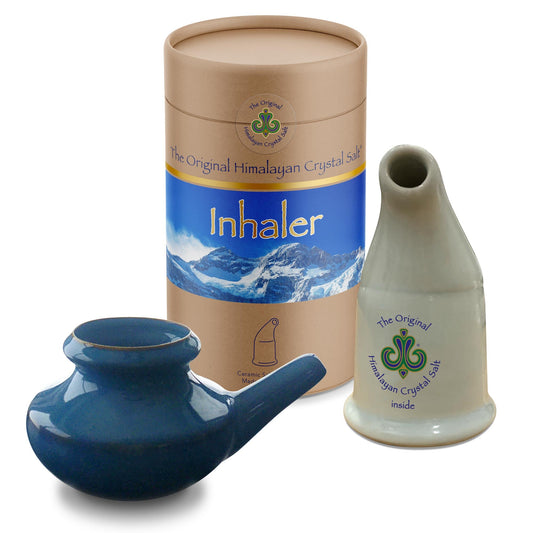
Neti pots, rooted in Ayurvedic medicine, are designed to flush out the nasal passages using a mild saline solution. This simple practice supports:
- Thinner mucus and easier nasal flow
- A clearer nasal passage
- Comfort during seasonal challenges
How Original Himalayan Crystal Salt Inhalers Work
Speleotherapy (salt cave therapy) was first developed after researchers observed that Polish salt miners experienced fewer pulmonary issues than the general population. Halotherapy, a more modern version of this concept, recreates salt-rich air environments in wellness settings. While effective for some, these therapies can be costly and time-intensive.
A more accessible option is dry salt inhalation using a ceramic salt inhaler. This device contains a chamber of natural salt crystals, which air passes over as you inhale. The result is a salt-infused vapor that coats the respiratory tract.
According to the Lung Institute, this type of salt exposure may help support the body's natural mucus clearance, reduce congestion and ease breathing.*
In a pilot study of 35 patients with chronic obstructive pulmonary disease (COPD), regular use of a dry salt inhaler was associated with improved six-minute walk times, a marker of improved endurance and respiratory function.¹⁰
While dry salt inhalation is not a treatment for chronic respiratory conditions, many individuals use it to support comfort and quality of life. It may be especially helpful when used daily, with typical sessions lasting 5 to 20 minutes. To date, no contraindications have been observed when used alongside medications.
The Type of Salt Matters
Not all salt is created equal. Commercial table salts may contain chemical additives or have larger, irregular particles that may irritate sensitive tissue. Original Himalayan Crystal Salt is prized for its purity, fine crystalline structure, and full-spectrum mineral content.
Under intense geological pressure, this salt forms uniquely small, uniform particles that may be more easily absorbed. It also contains 84 trace and ultra-trace minerals, including many elements valued by practitioners of traditional energy-based therapies.
Original Himalayan Crystal Salt Inhalers are handmade in the U.S. using lead-free materials and BPA-free components. Each refill lasts up to 18 months and is backed by structural and mineral testing for quality assurance.
Bringing It All Together
Salt therapies reflect a tradition rooted in both simplicity and science. As modern research continues to explore their mechanisms, these practices remain a gentle, natural way to support the body's innate clearing and protective processes.